
With the daily news replete with all manner of climate disasters of Biblical proportions—forest fires, floods, droughts, storms, melting glaciers, record heat and cold—it’s easy to feel hopeless about global climate change. What can I do to make a hill of beans worth of difference? In fact, there is one significant action many of us can take that can truly reduce our consumption of fossil fuels: Go solar.
And now is the time to do it. Concerned about the cost? A federal tax credit extended by President Biden within days of taking office will cover 30% of your expense. Eyeing a new electric vehicle? Let your rooftop panels charge it up. Not sure where to start? Sign up before August 31 to participate in Solarize Alexandria, which is a partnership between the City of Alexandria, the Northern Virginia Regional Commission and a nonprofit organization called LEAP. Everyone who signs up gets a free assessment from a participating installer, a valuable list of vetted installers (beware of fly-by-night firms that solicit door-to-door, use aggressive sales tactics, or offer to install solar panels “for free”) and other helpful information.
The Case for Solar
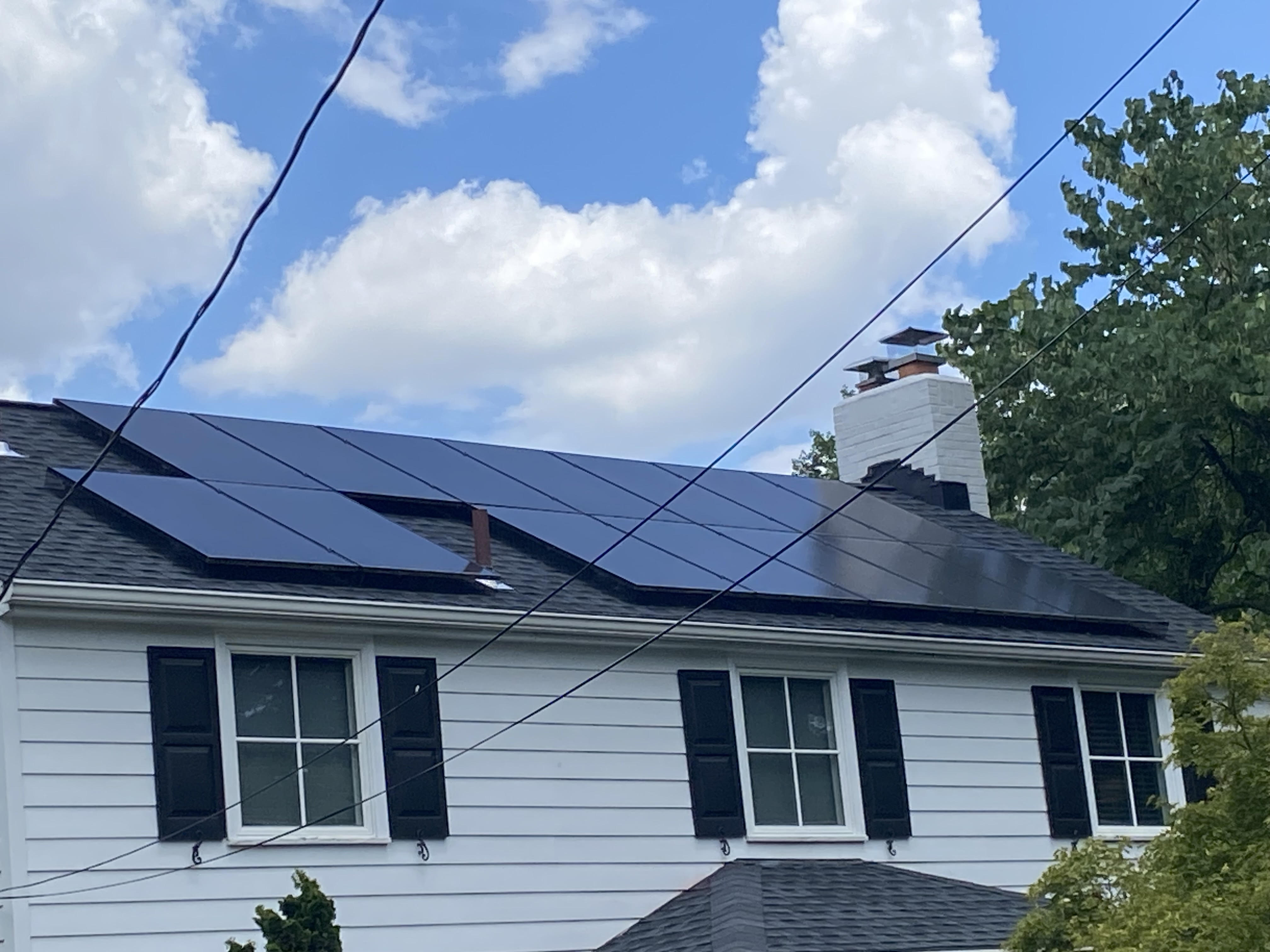
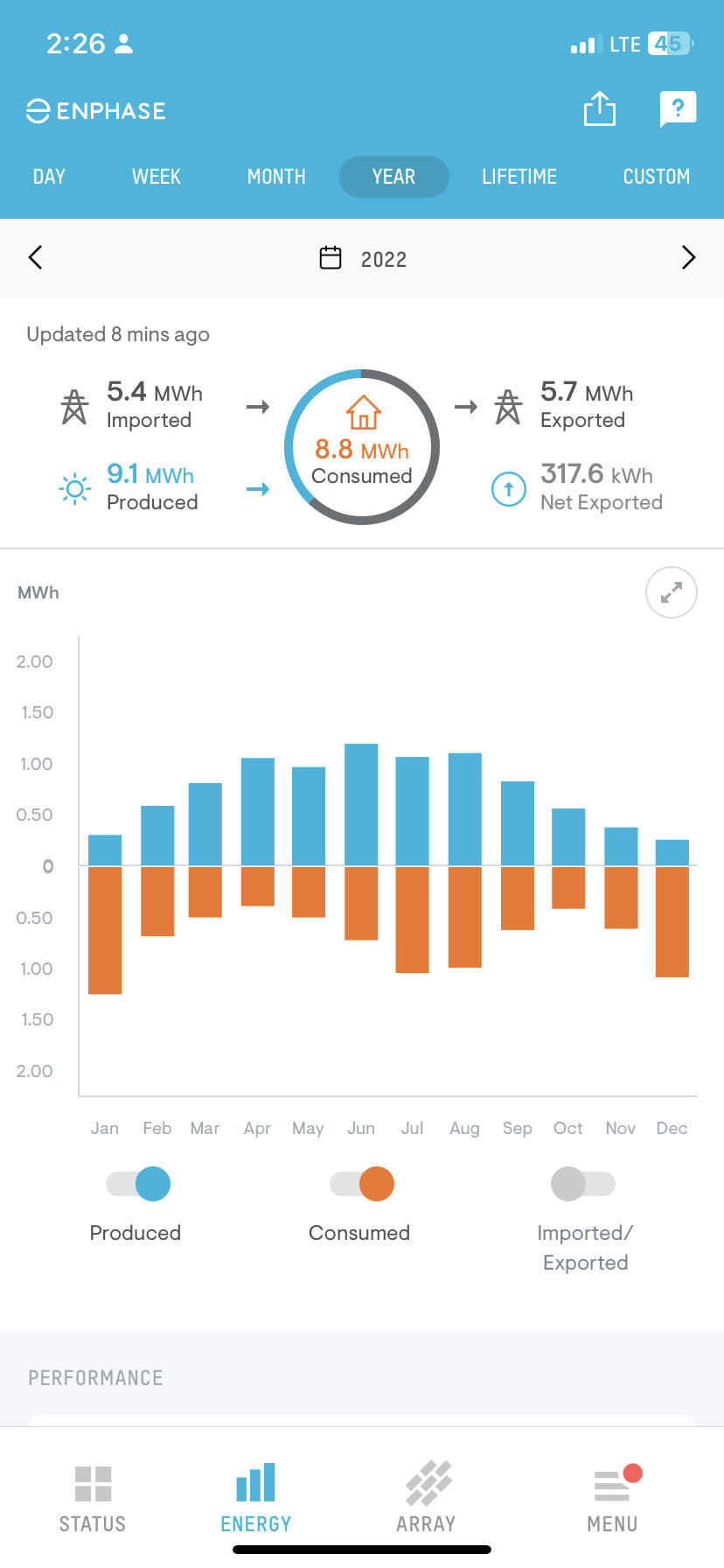
The company we chose to do our installation, Solar Energy World* based in Laurel, Md., estimated that our 27 panels spread across both our south-facing and north-facing roof slopes would generate 70% of our electricity needs over the course of a year. That turned out to be conservative. After nearly three years of operation, the system is generating a little more than 100% of what we need annually. Even on the shortest day of the year in December when it was cloudy and cold, our system generated about 20% of the electricity we used that day. The system comes with a somewhat addictive app called Enphase that gives you real-time updates and comparisons of your production and consumption, and also allows you to check that each panel is operating properly.
We have a mixed-fuel system in our house: We heat the main level using natural gas. Heating upstairs and cooling throughout the house are done using electricity. Our water heater, stove, and oven run off of natural gas.
Our solar system generates more power than we use during the spring, summer and fall; we run a deficit during the winter. Dominion Energy sends us kWh whenever we need to supplement what we produce; when we’re generating more than we need, the surplus goes onto the grid.
Dominion keeps track of all this using net metering, so we only pay for the net of what we import from the grid. Because we’ve been running a surplus since the panels were installed, our electricity bill is down to $7.70 per month, which consists of a $6.58 fee for distribution service (the cost for the equipment such as wires and transformers that Dominion uses to deliver electricity) plus the $1.12 Alexandria City utility tax. Dominion doesn’t actually pay us for the surplus electricity we’ve generated; the extra kWh we’ve exported to the grid accumulate as a credit we can draw down in the future if our electricity needs go up (for example, if and when we purchase an electric vehicle).
So how does this all wash out financially? It may take 10 years before we recover the nearly $15,000 we spent on the installation (after the tax credit, which was 26% in 2020 when we purchased our system). Future increases in electricity rates would reduce the length of the payback period, of course. And at the time, we didn’t factor into the cost-benefit equation a higher resale value for our house. Given the recent and projected increase in popularity of EVs, I would now consider our system to be a selling point if we were planning to list our home.
Both the installation cost and the amount of energy your system generates depend on how many panels you install. We installed 27 panels even though Solar Energy World’s data showed that we could have added a few more (which we opted against mainly for aesthetic reasons). We were also pleasantly surprised at how unobtrusive the panels look from the curb.
Other considerations
One benefit of going solar is the intangible sense of knowing that you are making a small investment in our children’s and their children’s future planet. But no matter how passionate you are about slowing climate change, the sun’s rays need to have a direct path to the photovoltaic panels for the system to operate. Luckily there’s an app for that! Click here to see how much sun exposure your roof gets. You’ll be surprised at how much orange color there is even in our neighborhoods with many mature trees.
The solar energy companies generally won’t install a system on a house if the roof is more than 10 years old. Ours was 20 years old and needing replacement, so the timing was good, and we chose a roof shingle color to match the solar panels as much as possible. Even though they are an additional cost, critter guards around the panels are a worthwhile purchase. Not long after our panels were installed, squirrels were busily building nests under them, right next to wiring that is a delicacy for the rodents.
Lowering the barriers to solar adoption
As my husband and I biked through Flanders fields last summer, I observed that about half of homes in Belgium have solar panels. As I drive around the southern half of the East Coast, I am dismayed that I see hardly any. Dominion Energy reports that the number of business and residential customers using net metering has increased from 770 to more than 31,000 in the past decade, but that’s out of 2.6 million customers. Even with the generous federal tax credit, the upfront installation costs are too great a barrier for many homeowners and business owners.
What can be done to increase take-up of residential solar energy? The Solarize Alexandria partnership is a great first step, but it’s not enough. The only tax break provided by local jurisdictions in the state of Virginia is exempting the value of your solar energy system from your property’s assessed value. Some states exempt solar energy systems from sales tax. Thirteen states provide both exemptions.
A 2015 study in Texas showed that even among those with higher than average educational attainment, awareness of solar energy costs, benefits and the availability of a federal tax credit was low. The City of Alexandria should consider including information about Solarize Alexandria as well as the federal tax credit and local property tax exemption for solar panels in property tax assessments that are mailed each year to homeowners.
The Texas study also showed that peer effects are important in the adoption of solar. (When one homeowner makes the investment, others nearby are more likely to follow suit.) Civic and neighborhood associations could help in that regard by inviting a representative from the Solarize Alexandria partnership (along with residents who have adopted solar) to speak at a membership meeting.
Homeowners’ association (HOA) communities, which nationally include 53% of all homeowners and 82% of all new homes built in 2021, can often be a hindrance for those wishing to invest in solar. Twenty-eight states, including Virginia, and D.C. have passed solar access laws protecting a homeowner’s right to adopt solar. Unfortunately, even in states with solar access laws, many HOAs still either prohibit or enact unreasonable restrictions on solar installations. Under Virginia state law, HOAs typically cannot prohibit solar installations, but the law allows “reasonable restrictions concerning the size, place, and manner of placement.”
Congress could help by passing a national solar access law. Also at the federal level, the existing tax credit could be augmented with a tax credit for interest paid on a home equity loan that’s used for the installation.
Further reading:
Half of Americans can’t install solar panels. Here’s how they can plug into the sun.
*I have no financial interest in the form of a commission or otherwise in either Solar Energy World or Dominion Energy.
Categories: Uncategorized
Tags: City of Alexandria, Dominion Energy, solar panels, Solarize Alexandria
 Port City Notebook
You must be logged in to post a comment.